
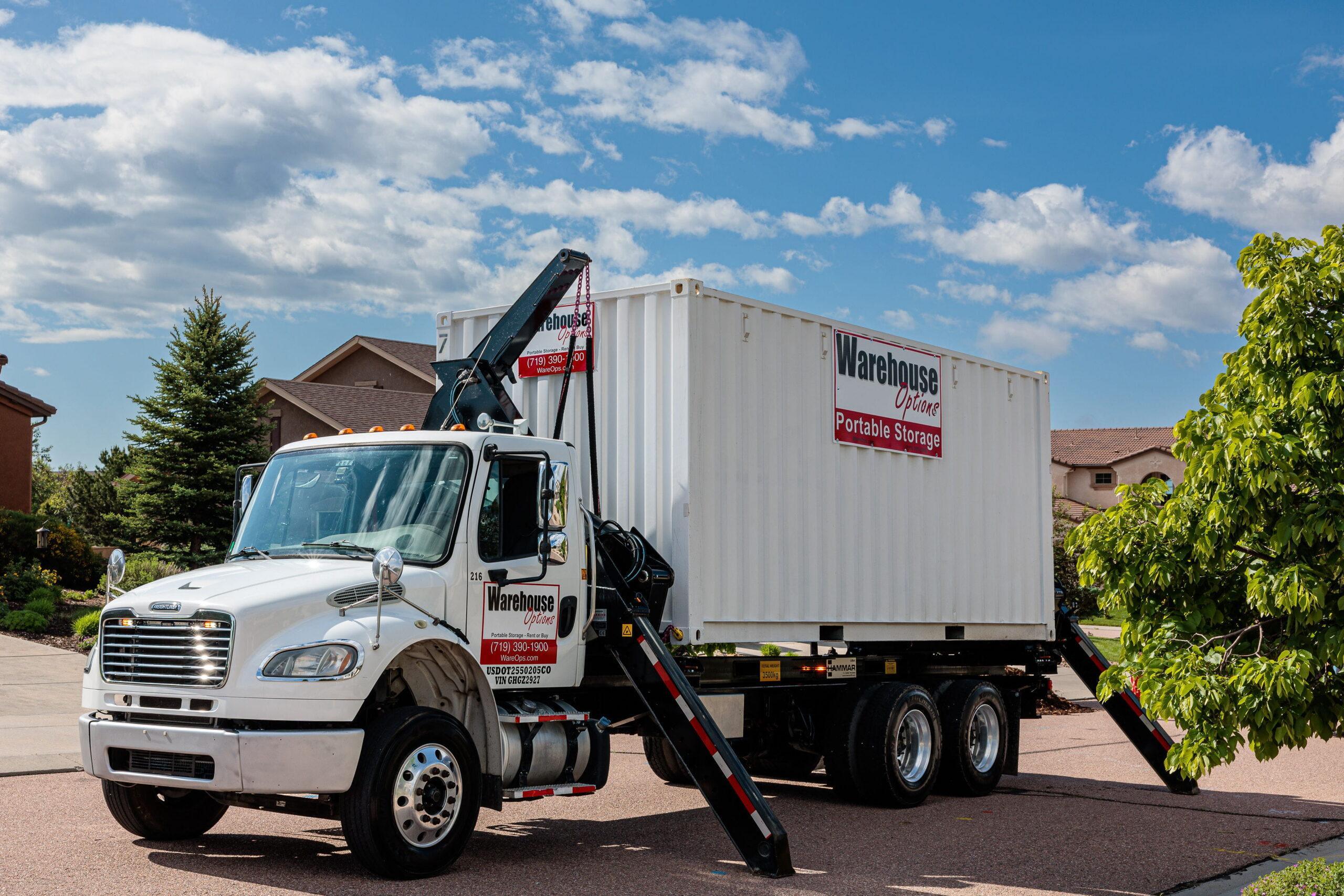
Shipping container prices in Colorado have settled after the wild swings of 2021 through 2023. Steel costs are stable. Import flows from Pacific ports have normalized. That makes 2026 one of the better windows to lock in a container, whether you rent or buy.
But “stable” does not mean “cheap.” Your final number depends on the container size, its condition, how far it travels from the yard, and whether your site needs prep work to handle Colorado weather.
This guide breaks down real pricing from the Colorado Springs market. No ranges pulled from national averages. No “call for a quote” runaround. Actual numbers by size and condition, plus the cost levers that move your total up or down.
What Shipping Containers Cost in Colorado Right Now
Colorado container prices track slightly above the national average. The Front Range construction boom, military installations along the I-25 corridor, and limited local depot inventory all push demand.
Here is the short version. A used 20-foot container runs $1,800 to $3,200 to purchase. A new one-trip 40-foot high cube tops out around $5,500 to $7,000. Rentals land between $100 and $200 per month depending on size and term length.
Those ranges shift based on three things: where the container sits today, what condition it’s in, and where you need it delivered. A container priced at $2,800 in Denver could cost $3,400 landed at a foothills property west of Colorado Springs once you factor delivery and site access.
The numbers below come from the Colorado Springs market, where Warehouse Options operates a local yard. Local yards cut the delivery variable down because the truck is not running 70 miles from a Denver depot. That difference shows up in your quote.
Colorado Springs Container Rental Prices by Size and Condition
Renting makes sense for short-term projects: home renovations, seasonal inventory overflow, construction staging, and military PCS moves. Here is what monthly container rentals in Colorado Springs look like in 2026.
| Container | Condition | Monthly Rate | Weekly Rate |
| 20-foot standard | Used, wind/water tight | $100 – $135 | $45 – $60 |
| 20-foot standard | One-trip | $120 – $150 | $50 – $65 |
| 40-foot standard | Used, wind/water tight | $140 – $175 | $55 – $75 |
| 40-foot high cube | One-trip | $160 – $200 | $65 – $85 |
What’s included: Delivery to your site and pickup when you’re done. No hidden fuel surcharges.
What’s not included: Lockboxes, shelving, or electrical packages. Those are add-on accessories.
Weekly rates work for construction contractors who need 6 to 10 weeks of staging storage. Monthly rates suit homeowners in the middle of a remodel or businesses storing seasonal stock.
If you need the container longer than 12 months, buying usually saves money. We cover that math below.
Purchase Prices for 20-Foot and 40-Foot Containers
Buying a container makes sense when you need storage for more than a year, when you plan modifications, or when you want an asset on your property with no recurring payments. Here is what it costs to buy a shipping container in Colorado Springs in 2026.
| Container | Condition | Price Range |
| 20-foot standard (8’6″ tall) | Used, wind/water tight | $1,800 – $2,600 |
| 20-foot standard | One-trip | $3,000 – $4,200 |
| 20-foot high cube (9’6″ tall) | One-trip | $3,400 – $4,800 |
| 40-foot standard | Used, wind/water tight | $2,400 – $3,600 |
| 40-foot standard | One-trip | $4,200 – $5,800 |
| 40-foot high cube | One-trip | $5,000 – $7,000 |
The 40-foot high cube is the most requested unit for commercial buyers. The extra foot of ceiling height (9’6″ vs 8’6″) accommodates racking, pallets, and oversized equipment. If you are pricing out a 40-foot high cube storage container, expect to pay a 15% to 20% premium over a standard-height unit in the same condition.
One-trip vs used: A one-trip container has made one ocean crossing from the factory. The floors are clean, the paint is fresh, and the rubber door seals are tight. A used wind-and-water-tight (WWT) container is structurally sound but shows surface wear, minor dents, and some surface rust. For storage, WWT containers work fine. For a client-facing build-out or container office, one-trip is worth the premium.
National Container Companies vs a Local Colorado Provider
If you search “cheap shipping containers sale” or “mobile mini container prices,” you will find national brands like WillScot Mobile Mini, PODS, and various online brokerages. They serve the entire country from regional depots.
Here is the pricing model difference that matters to your wallet.
National companies quote a base container price, then add delivery from the nearest regional hub. If the nearest hub is Denver, that delivery charge to a Colorado Springs address runs $350 to $600 depending on the truck type and route. Some add pickup fees, fuel surcharges, and admin charges on top. Monthly rentals from national portable storage brands commonly run $149 to $359, and that is before delivery and pickup fees of $150 to $250 each way.
A local provider with a Colorado Springs yard prices differently. The container does not travel 70 miles on a flatbed. Delivery distances are shorter. Fuel costs are lower. There is no regional dispatch layer adding overhead. That translates to lower landed cost on both purchases and rentals.
This is not a knock on national providers. They cover areas local companies can not reach. But if you’re in Colorado Springs, Pueblo, Woodland Park, Canon City, or anywhere in southern Colorado, getting a quote from a local yard first sets your pricing baseline. You will know immediately whether the national quote is competitive or padded.
Get a flat quote on your container from a Colorado Springs yard before you compare national pricing.
Five Cost Levers That Move Your Price in Colorado
The sticker price on a container is only part of the story. These five factors change your total cost, sometimes by thousands.
Delivery distance from the yard. Every mile between the container yard and your site adds cost. A delivery within Colorado Springs runs less than a delivery to Salida, Buena Vista, or Cripple Creek. If you are near the I-25 corridor from Pueblo to Castle Rock, delivery costs stay reasonable. Once you move west into the mountains, expect the delivery charge to climb.
Terrain and site access. Foothills and mountain properties west of Colorado Springs often have steep driveways, unpaved roads, and tight turns. Standard tilt-bed trucks need 70 to 120 feet of straight clearance depending on the container length. If your site can not accommodate that, you may need a crane drop, which adds $500 to $2,500 to the delivery.
Modification costs. A bare container stores your stuff. A modified container works for you. Common upgrades and their approximate costs:
Turbine vent kit: $75 – $150
Lockbox (puck lock compatible): $50 – $100
Electrical package (lights, outlets, panel): $1,200 – $3,000
Roll-up door conversion: $1,500 – $2,500
Personnel door with frame: $800 – $1,500
If you need a custom container modification, build those costs into your total budget before you compare against renting a finished unit.
Condition grade. The spread between a used WWT 20-footer and a one-trip 20-footer is $1,200 to $1,600. For pure storage, the used unit does the same job. For an office conversion or customer-facing application, one-trip saves money on prep work because you skip repainting and floor refinishing.
Rental term length. Longer terms usually earn lower monthly rates. A 12-month commitment on a 20-footer may come in at $100 per month. A month-to-month rental on the same unit could run $135 or more. If you know you need six months or longer, lock in a term rate.
Snow Load, Wind Ratings, and Ground Prep for Colorado
Colorado is not Florida. It is not Kansas either. The weather here creates real costs that buyers in other states do not face.
Snow load. Ground snow loads in the Colorado Springs area range from 25 to 35 PSF (pounds per square foot). Mountain communities west of the Springs can hit 50 to 70+ PSF. A standard ISO shipping container handles snow load on the roof because of its corrugated steel design, but containers placed in heavy snow zones need clear drainage paths and should not accumulate drifts against the doors.
Wind. Colorado Springs regularly sees wind gusts of 60 to 80 mph, especially along the eastern edge of the city and in areas like Black Forest and Falcon. An empty 20-foot container weighs about 4,850 pounds. An empty 40-footer weighs roughly 8,200 pounds. That is heavy, but sustained winds can shift an empty container that sits on bare ground. Anchoring with tie-down stakes or concrete anchor blocks costs $150 to $400 and is worth every dollar.
Ground prep. Place your container on level, compacted ground. A simple gravel pad runs $200 to $600 for a DIY install. Concrete blocks or railroad ties at the four corner castings cost $50 to $150. Sloped sites or soft ground may need a poured pad at $1,500 to $3,500. Ask your provider about site requirements before delivery day.
These costs are small compared to the container itself, but skipping them leads to problems: stuck doors from uneven settling, rust from standing water underneath, and insurance headaches if a container shifts in a windstorm.
Rent or Buy: When Each Option Saves You Money
The breakeven point between renting and buying a container depends on how long you need it.
Rule of thumb: If you need a container for 12 months or less, rent. If you need it for 18 months or longer, buy. The gray zone is 12 to 18 months, and that depends on which unit you are considering.
Here is the math on a 20-foot used container:
Purchase price: $2,200 (used WWT, delivered)
Monthly rental: $115 per month
Rental delivery + pickup: $350 total
At $115 per month plus $350 in delivery and pickup, your rental cost hits $2,230 at month 16. That is where buying starts to win. After that point, every month of continued rental is money you could have put toward ownership.
For 40-foot high cube containers, the purchase price is higher, so the breakeven point extends to roughly 20 to 24 months.
If you are unsure about your timeline, start with a rental. Most local providers, including Warehouse Options, offer flexible terms that let you convert a rental into a purchase if your needs change.
A note for military families near Fort Carson, Peterson Space Force Base, and USAFA: PCS moves create unpredictable timelines. Ask about flexible rental terms that accommodate orders changes and extension scenarios. Local providers near military installations are accustomed to working with service members and can adjust terms when orders shift.
Get Your Container Price Locked In
Container prices in Colorado are stable in 2026, but supply fluctuates with construction season demand. Spring and summer bookings fill local inventory faster than fall and winter.
If you know you need a container in the next 60 days, get your quote now. Pricing holds for a limited window, and delivery slots fill on a first-come basis during peak months.
Get a flat quote on your container from Warehouse Options in Colorado Springs. Tell us the size, condition, and delivery location. We will send back a single number, delivered, no surprises.
Or call us directly. We answer the phone.